Sangeh Monkey Forest offers a different way to experience Bali, combining a shaded forest of towering trees, free roaming long tailed macaques, and a sacred Balinese temple within the same setting. Located in Sangeh Village, Badung Regency, it is a worthwhile stop for travelers interested in nature, local traditions, and places beyond Bali’s busiest tourist areas.
Unlike a visit focused solely on observing monkeys, exploring Sangeh also means discovering the forest’s cultural significance and the role it continues to play in the surrounding community. The experience is relatively easy to include in a day trip, particularly if you are exploring central Bali or the areas around Ubud.
If you are planning a visit, this guide covers what makes Sangeh Monkey Forest special, how much time to allow, entrance fees, opening hours, transportation options, and practical tips for enjoying the forest responsibly.
Where Is Sangeh Monkey Forest?
Sangeh Monkey Forest is located in Sangeh Village, Abiansemal District, Badung Regency, Bali, Indonesia. The attraction sits approximately 25 kilometers from Denpasar, although your actual travel time will depend on your starting point, route, and traffic conditions.
The forest is accessible by road, making it suitable for a half day excursion or as part of a broader Bali sightseeing itinerary. Travelers staying in Ubud, Canggu, Seminyak, or other popular areas can arrange a visit, but the journey should be planned around the other places they intend to explore.
The surrounding area has a more rural character than Bali’s major resort districts. This setting is part of what makes the journey worthwhile, especially for visitors who want to see a different side of the island.
What Makes Sangeh Monkey Forest Special?
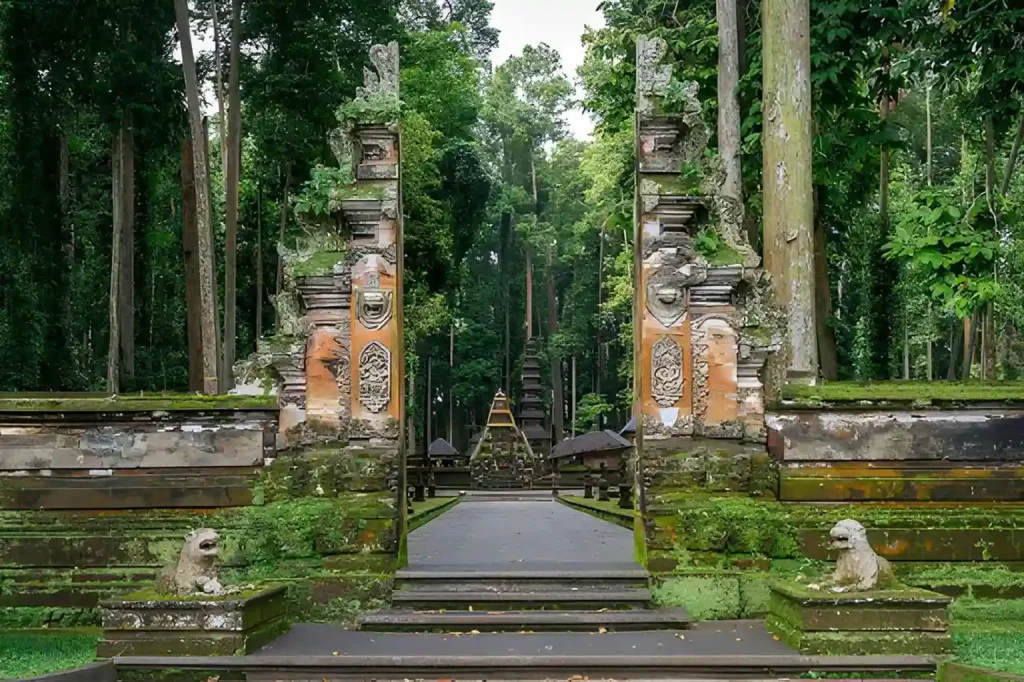
Sangeh is more than a place to encounter monkeys. Its appeal comes from the combination of forest ecology, Balinese spiritual traditions, and wildlife living within a landscape that has been important to the local community for generations.
1. A Sacred Forest Dominated by Nutmeg Trees
One of Sangeh’s defining features is its dense canopy of tall trees. The protected nature tourism area covers approximately 13.91 hectares and is known for its characteristic pala forest, creating a shaded environment that feels different from Bali’s open coastal landscapes.
The forest is officially recognized as Taman Wisata Alam Sangeh, or Sangeh Nature Tourism Park. According to Bali’s natural resources conservation authority, the area was designated a nature tourism park in 1993, following an earlier period as a nature reserve.
The trees provide the setting for the entire visit. Rather than moving between separate attractions, you can explore a forest landscape where wildlife, vegetation, and sacred spaces exist together.
Walking beneath the canopy also offers a welcome change from exposed outdoor attractions, although Bali’s tropical humidity means you should still bring water and wear comfortable footwear.
2. Pura Bukit Sari and Balinese Spiritual Heritage
Pura Bukit Sari is one of the most significant cultural features of Sangeh Monkey Forest. Located within the forest, the temple is associated with the history of the Mengwi Kingdom and dates back to the seventeenth century.
For the local community, this is a sacred place rather than simply a scenic backdrop. The temple’s presence helps explain why Sangeh should be approached with respect for Balinese Hindu traditions.
Visitors interested in local culture can appreciate the relationship between the forest and its religious heritage while observing any restrictions that apply to temple areas. Not every space is necessarily open to general visitors, so follow posted rules and guidance from local staff.
This cultural dimension makes Sangeh particularly interesting for travelers who want to understand more about Bali beyond its landscapes and popular photo locations.
3. Long Tailed Macaques in Their Forest Habitat
Sangeh is home to long tailed macaques (Macaca fascicularis), the species commonly encountered at several monkey forest attractions across Bali.
Bali’s conservation authority reports a population of approximately 600 macaques in the Sangeh nature tourism area, divided into three groups. The exact population may change over time.
During your visit, you may see monkeys moving along pathways, resting on branches, grooming one another, or interacting within their social groups. Their behavior is not always predictable, and their proximity to visitors can vary.
Although these animals are accustomed to the presence of people, they remain wild animals. Observe them from a respectful distance rather than attempting to touch, chase, or provoke them.
4. Local Legends and the History of Sangeh
The forest is also connected to local Balinese stories and traditions. One commonly shared explanation of the name Sangeh relates to the words sang and ngeh, interpreted in local folklore as a reference to people seeing something.
The surrounding legends connect the forest to sacred traditions and the movement of trees through a mythical landscape. As with many traditional stories in Bali, these accounts form part of the area’s cultural identity rather than a historical record that can be independently verified in every detail.
You do not need to know every legend to enjoy the visit, but understanding that Sangeh has cultural and spiritual significance adds context to the landscape you see.
Things to Do at Sangeh Monkey Forest
A visit to Sangeh is best approached as a relaxed forest walk rather than an attraction where you need to complete a long list of activities.
Here are the main experiences to include in your visit.
1. Walk Through the Shaded Forest
Follow the visitor pathways and take time to appreciate the scale of the trees and the atmosphere beneath the canopy. The forest is the main attraction, so there is no need to rush directly from the entrance to the monkeys.
Allow yourself time to observe the surroundings, particularly if you enjoy nature photography or quieter outdoor experiences.
2. Observe the Monkeys Responsibly
Watching the macaques is one of the main reasons people visit Sangeh. Their social behavior can be fascinating, from grooming and resting to moving between different parts of the forest.
Keep your distance, avoid making sudden movements, and never try to force an interaction for a photograph. Follow the staff’s instructions whenever monkeys approach visitors or gather near a pathway.
3. Appreciate the Temple and Local Culture
Pura Bukit Sari provides an opportunity to appreciate the relationship between Balinese Hindu traditions and the surrounding landscape.
Observe the temple from permitted areas and dress respectfully. If you are uncertain about photography, access, or local customs, ask a member of staff before proceeding.
4. Take Forest and Wildlife Photographs
The tall trees, filtered light, and monkeys can create interesting photographic opportunities. A camera or phone is useful, but keep your equipment secure throughout the visit.
Avoid getting too close to wildlife to capture a particular shot. A natural photograph taken from a safe distance is preferable to an interaction that disturbs the animals.
Sangeh Monkey Forest Entrance Fee and Opening Hours
Sangeh Monkey Forest is generally listed as open daily from 8:00 AM to 5:00 PM WITA, or Central Indonesia Time.
Published entrance fees can differ between official tourism information and ticketing platforms. Indonesia Travel lists the following visitor rates:
| Visitor category | Published entrance fee |
|---|---|
| International adult | IDR 75,000 |
| International child, ages 3–10 | IDR 50,000 |
| Domestic adult | IDR 15,000 |
| Domestic child, ages 3–10 | IDR 5,000 |
How Long Do You Need at Sangeh Monkey Forest?
For most visitors, around one to two hours is a reasonable starting point for exploring Sangeh Monkey Forest.
A shorter visit may be sufficient if you mainly want to walk through the forest and observe the monkeys. If you enjoy photography, want to appreciate the temple surroundings, or prefer a slower pace, allow additional time.
Your overall schedule should also account for driving time. Sangeh is not in the center of Ubud, so visiting it alongside other attractions requires some thought about the route.
For example, a morning visit followed by lunch and another nearby attraction can work well without turning the day into a rushed sequence of stops.
The key is to leave enough time to enjoy the forest itself instead of treating it as a quick photo stop between distant destinations.
You may also want to read this guide: Ubud Full Day Private Tour with Marina Bali Tours: A Seamless One Day Experience
How to Get to Sangeh Monkey Forest
The most practical way to reach Sangeh Monkey Forest depends on where you are staying and how many other places you plan to visit.
1. By Private Car or Driver
A private car with a driver is a convenient option for travelers who want to combine Sangeh with other destinations.
You can plan your departure time, arrange stops along the route, and avoid the need to coordinate separate transport for every part of the day. This is particularly useful for families, couples, or small groups with several places on their itinerary.
Travel times vary with traffic, so use your accommodation as the starting point when estimating the journey.
2. By Scooter
Travelers who are experienced and legally permitted to ride in Bali may choose a scooter for greater flexibility.
However, consider your riding experience, weather conditions, road familiarity, and insurance coverage before choosing this option. Do not assume that a scooter is the easiest choice simply because the distance looks manageable on a map.
3. By Organized Tour
An organized tour can make sense if Sangeh is one of several places you want to visit in a single day.
Rather than arranging every transfer separately, you can plan a route that connects attractions in a logical order. The best itinerary will depend on where you are staying, which destinations matter most to you, and how much time you want to spend at each stop.
For travelers who value a comfortable and flexible sightseeing experience, this can be a practical way to explore the surrounding region
Best Time to Visit Sangeh Monkey Forest
The best time to visit Sangeh Monkey Forest is in the early morning, ideally between 8:00 AM and 10:00 AM. Temperatures are generally more comfortable during these hours, making it easier to explore the shaded forest before the midday heat. You may also find the pathways quieter earlier in the day, although visitor numbers and monkey activity can vary.
Sangeh Monkey Forest is generally open daily from 8:00 AM to 5:00 PM, giving you flexibility to plan your visit around other attractions in Bali.
Best Time of Day to Visit
- Morning (8:00 AM–10:00 AM): A good choice for cooler conditions and a more relaxed walk beneath the forest canopy. Arriving early also leaves more time to explore other destinations later in the day.
- Midday (11:00 AM–2:00 PM): Temperatures are usually warmer, and monkeys may spend more time resting in shaded areas. The dense tree canopy provides some shelter from direct sunlight.
- Afternoon (3:00 PM–5:00 PM): An alternative for visitors who prefer a later start. Allow enough time to explore before the attraction closes, and check current operating hours before setting out.
Monkey behavior is unpredictable, so no particular time guarantees that you will see more active animals.
Best Season to Visit Sangeh Monkey Forest
Bali has two main seasons, and each offers a slightly different experience when visiting Sangeh.
- Dry season (April–October): Often the more convenient period for outdoor sightseeing, with generally drier conditions and a lower chance of rain disrupting your plans. However, weather can still vary, and some days may be hot or overcast.
- Wet season (November–March): The forest can look especially lush during the rainy months, but showers may leave pathways damp or slippery. Bring suitable footwear and check the weather forecast before visiting.
Monkey Safety Rules and Visitor Etiquette
Enjoying Sangeh responsibly means remembering that the monkeys are wild animals and the forest includes sacred areas.
A few practical precautions can help make the experience more comfortable.
1. Keep Your Belongings Secure
Store loose items such as sunglasses, hats, phones, and food in a closed bag. Avoid displaying snacks or carrying accessories loosely when monkeys are nearby.
Macaques can be curious about objects held by visitors. Keeping your belongings secure reduces the temptation for an animal to grab them.
2. Do Not Touch, Chase, or Provoke the Monkeys
Never attempt to grab a monkey, corner it, pull its tail, or force it into a photograph.
Avoid sudden movements and do not deliberately stare at an animal at close range. If a monkey approaches, remain calm and follow the instructions of the local staff.
3. Follow Feeding Rules
Do not assume that you are permitted to feed the monkeys simply because food is sold near a tourist attraction.
Feeding policies can vary, and unmanaged feeding may encourage unwanted interactions. Follow the current rules set by the Sangeh management team and do not offer food unless it is explicitly permitted under their guidance.
4. Respect the Temple and Local Customs
Keep noise to a reasonable level and follow all signs relating to temple access, photography, clothing, and visitor behavior.
Remember that Sangeh is both a tourism destination and a culturally significant place. Treating it respectfully is part of having a positive visit.
What If a Monkey Grabs Something?
Do not attempt to wrestle an item away from a monkey or escalate the interaction. Move calmly, maintain a safe distance, and seek help from the local staff.
If you are bitten or scratched, wash the wound promptly with soap and running water and seek urgent medical assessment for appropriate treatment, including rabies exposure evaluation. Do not wait for symptoms to develop.
You may also want to read this: Bali Temple Guide: How to Experience Bali’s Sacred Sites the Right Way
Sangeh Monkey Forest vs Ubud Monkey Forest
Sangeh Monkey Forest and the Sacred Monkey Forest Sanctuary in Ubud both combine macaque encounters with forest surroundings and Balinese cultural heritage. However, their settings and locations create different experiences.
| Consideration | Sangeh Monkey Forest | Ubud Monkey Forest |
|---|---|---|
| Location | Sangeh Village, Badung | Central Ubud |
| Main character | Forest landscape, wildlife, and sacred temple | Forest, temple complex, and a major Ubud attraction |
| Surroundings | More rural village setting | Close to Ubud’s shops, restaurants, and other attractions |
| Best fit | Travelers exploring the Sangeh area or seeking a forest focused stop | Travelers spending time in Ubud who want an accessible wildlife and cultural attraction |
Neither destination is automatically better for everyone.
If your itinerary already includes central Ubud, the Ubud Monkey Forest may be easier to fit into the day. If you are exploring the Badung countryside or want to include a different forest and temple setting, Sangeh may be the more suitable choice.
Your accommodation, other planned stops, and preferred pace should guide the decision more than comparisons based solely on popularity.
You may also want to read this: Ubud Monkey Forest: Monkeys, Sacred Temples & Visitor Guide
Places to Visit Near Sangeh Monkey Forest
If you have additional time, consider combining your visit with another attraction in the surrounding area. Choose stops that make geographical sense rather than trying to cover every well known destination in Bali.
1. Taman Mumbul
Taman Mumbul is a nearby attraction known for its spring water, landscaped surroundings, and spiritual significance to the local community.
The Bali provincial tourism authority places it approximately five minutes from Sangeh Monkey Forest. Actual travel time depends on your exact starting point and road conditions.
It can be a suitable addition if you want to explore more of Sangeh Village without committing to a long drive elsewhere.
2. Ubud
Ubud offers a broader selection of cultural attractions, restaurants, shops, and experiences. Depending on your route and available time, you may choose to explore Ubud before or after visiting Sangeh.
However, avoid treating the two locations as if they were next door to each other. Traffic and the number of planned stops can affect how comfortably they fit into one day.
Read more: 15 Best Things to Do in Ubud For Ultimate Nature, Culture & Hidden Experiences
Other Central Bali Attractions
If you are planning a full day in central Bali, consider selecting additional attractions based on your interests, such as traditional villages, rice terraces, or cultural landmarks.
The best combination depends on the direction of travel. A well planned itinerary groups nearby places together and leaves enough time to enjoy each one.
Is Sangeh Monkey Forest Worth Visiting?
Sangeh Monkey Forest is worth considering if you want to experience Bali’s forest landscape, observe long tailed macaques, and learn about a sacred cultural site in one visit.
It is particularly suitable for travelers interested in nature and local traditions who do not mind spending time outdoors around free roaming wildlife.
However, it may not be the best choice if you are uncomfortable around monkeys, have very limited time, or are staying far away and would need to make a special trip solely for this attraction.
For most travelers, the decision comes down to how well Sangeh fits into the rest of their itinerary. When combined with nearby attractions, it can become a rewarding part of a broader exploration of Bali.
Explore Sangeh Monkey Forest Bali with Marina Bali Tours
Visiting Sangeh Monkey Forest is easier to plan when you consider how it fits into the rest of your Bali itinerary. Travel time, road conditions, and the distance between attractions can all affect how much you can comfortably explore in a day.
Marina Bali Tours helps travelers plan their Bali experiences around their preferred destinations, travel schedule, and sightseeing interests. Whether you want to explore cultural landmarks, discover Bali’s countryside, or combine several attractions in one trip, choosing a practical route can make your journey more comfortable.
If you are planning to visit Sangeh Monkey Forest alongside other destinations, explore our Bali tour packages to find an option that suits your travel plans.
Frequently Asked Questions About Sangeh Monkey Forest
Where is Sangeh Monkey Forest located?
Sangeh Monkey Forest is in Sangeh Village, Abiansemal District, Badung Regency, Bali, Indonesia. It is approximately 25 kilometers from Denpasar.
What are the opening hours of Sangeh Monkey Forest?
Indonesia Travel lists its operating hours as 8:00 AM to 5:00 PM daily. Confirm the current schedule before your visit, as operating arrangements may change.
How much is the entrance fee to Sangeh Monkey Forest?
Published prices vary by source and ticket type. Indonesia Travel lists IDR 75,000 for international adults and IDR 50,000 for international children aged 3–10. Confirm the latest rate before visiting.
How long should I spend at Sangeh Monkey Forest?
Allow around one to two hours for a relaxed visit. You may need additional time if you want to take photographs, explore the surrounding area, or combine the attraction with other stops.
Is Sangeh Monkey Forest safe for visitors?
Visitors can enjoy the attraction responsibly by keeping their distance from the monkeys, securing belongings, avoiding provocation, and following staff instructions. Because the macaques are wild animals, their behavior cannot be guaranteed.
What is the difference between Sangeh Monkey Forest and Ubud Monkey Forest?
Sangeh is located in a more rural setting in Badung and is known for its forest and Pura Bukit Sari. Ubud Monkey Forest is closer to central Ubud’s shops, restaurants, and other tourist attractions.
Can I visit Sangeh Monkey Forest with a private driver?
Yes. A private driver can be a convenient way to reach Sangeh and combine it with other destinations. Choose a route based on your accommodation, preferred stops, and available time.
Is Sangeh Monkey Forest suitable for children?
Families may enjoy observing the monkeys and exploring the forest, but children should remain under close adult supervision. Keep a safe distance from wildlife and follow the attraction’s rules throughout the visit.
What should I wear to Sangeh Monkey Forest?
Wear comfortable clothing and footwear suitable for walking outdoors. If you plan to visit the temple area, dress respectfully and follow any specific clothing requirements provided by the local management.